
A JOURNEY TO THE HEART OF THE RENAISSANCE
IN SARDINIA
Discovering the "Little Sistine Chapel" of Porto Pozzo
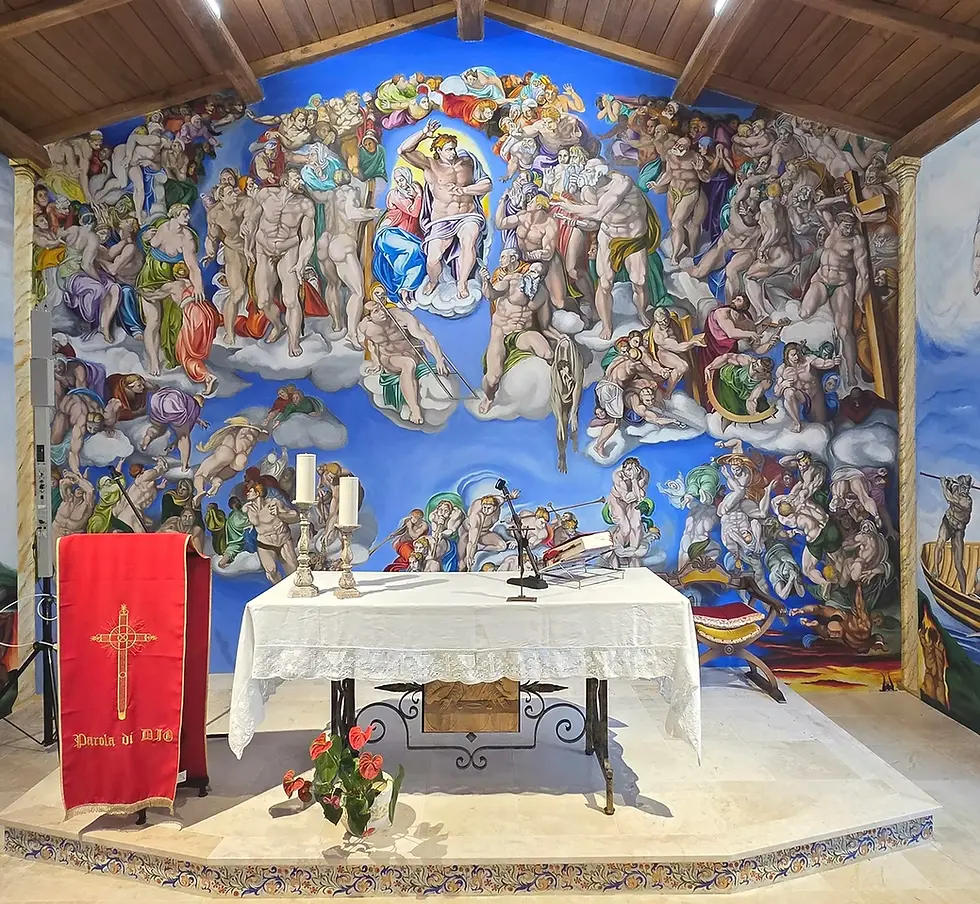
Michel Gardey created this fresco to SHARE his interpretation of the lost colours of the Renaissance AND to allow everyone to APPRECIATE the work of Michel Angelo.

In the center of the Sardinian village of Porto Pozzo, there is a small church dedicated to San Tommaso, built in the 1930s.
The French painter and copyist Michel Gardey, residing in Porto Pozzo, reproduced in this chapel part of Michel Angelo's works for the Sistine Chapel, respecting the exact proportions of the originals and the colorimetry.
We find The Last Judgment (never copied in this way), a fresco that constitutes a major turning point in the history of art,
the Delphic Sibyl, the most famous of the mediums, and scenes taken from the book of Genesis.
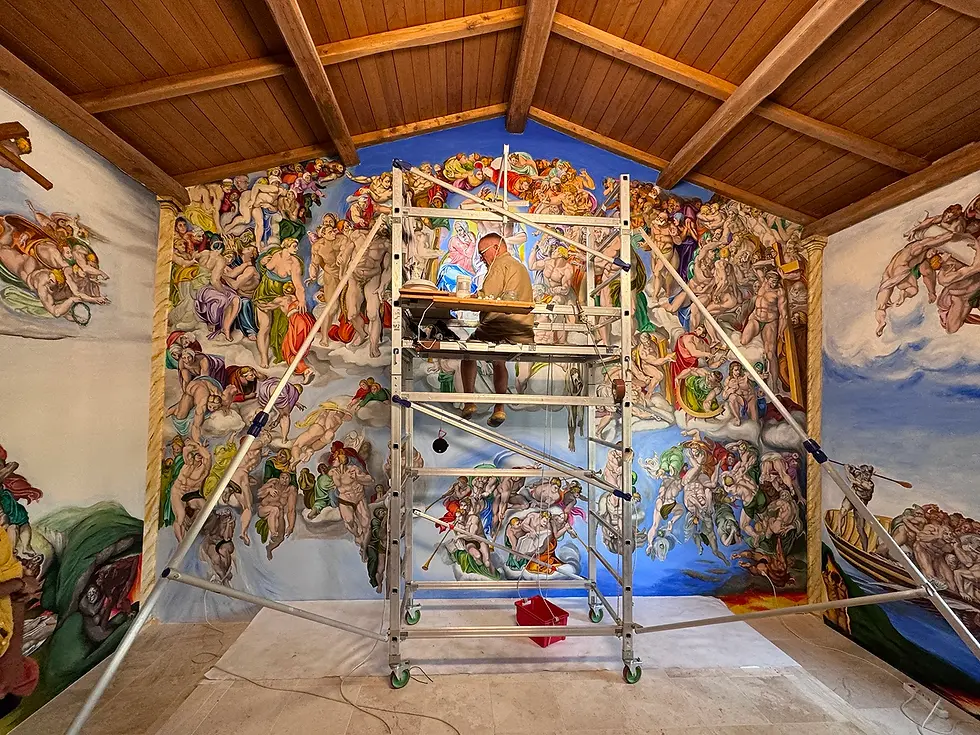
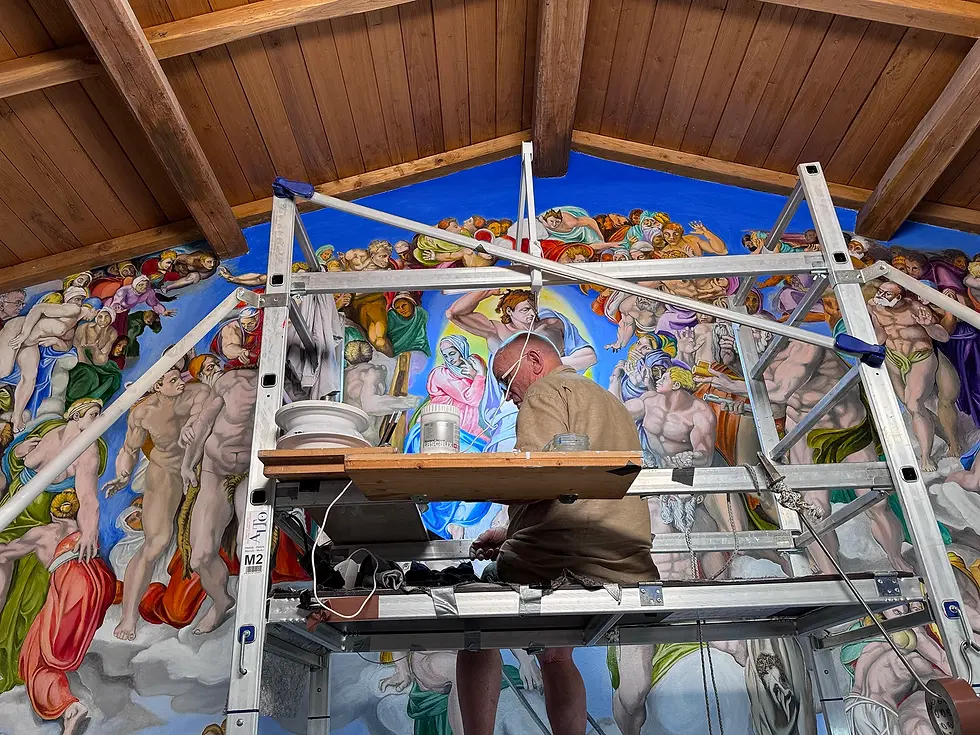
The entire project was conceived, directed and staged voluntarily over four years by Michel Gardey.
THE WORK


The Iconographic & Visual Journey
The entire project involves transposing the frescoes of the Sistine Chapel onto the church walls. To ensure continuity between the different scenes, the lower part of the walls is punctuated by a trompe-l'œil architectural design, composed of pillars and niches in faux white marble. This structure incorporates the thrones designed by Michelangelo for the ceiling of the Sistine Chapel, here adapted to human height to create an unprecedented sense of intimacy with the visitor.
1. The back wall (the altar): The Last Judgment
The visual journey begins on the back wall, behind the altar, which houses the monumental reproduction of the Last Judgment. Against an azure and ultramarine background, Christ the Judge raises an unyielding arm alongside the Virgin Mary, amidst a sea of humanity where the elect rise on the left while the damned tumble to the right. Higher up, in the lunettes of the vault, angels support the Cross and the column of the Flagellation.
The scenographic approach: Unlike the Vatican fresco, Michel Gardey here makes a staging choice by splitting the original composition, isolating the "Last Judgment" behind the altar to better shift the chaos onto the adjacent wall.
2. The return of the right wall (window side): Hell and Darkness
Extending the perspective along the return of the right wall, the atmosphere changes dramatically to depict Hell. The blue background gives way to a red and orange horizon. In the foreground of this section, at eye level, is the figure of Minos, while in the background, a group of demons emerges from the shadows beneath a sky of dark clouds.
This right-angle tilt breaks with Michelangelo's work. By detaching Charon's boat and Hell on the side wall, Michel Gardey creates a dramatic enveloping effect: the viewer finds themselves literally immersed alongside the damned.
3. The left wall: The stories of Genesis
On the left wall, the painter takes us back in time to the stories of Genesis. There we find the scene of Original Sin, symbolized by the Tree of Knowledge around which the human-shaped serpent is coiled, immediately followed by the expulsion of Adam and Eve by an angel wielding a sword. Higher up on the same wall, the Creation of the Stars shows the divine figure in motion, framing the sun on one side and the moon on the other against a background of blue and pink sky, all framed by two seated ephebes, or Ignudi, positioned on marble structures. Between these two scenes, Michel Gardey has created a horizon line punctuated by a celestial body, ensuring their continuity while reinforcing the spiritual dimension of the whole.
The adaptation here is purely spatial: while these mythical scenes form the spine of the Vatican ceiling (forcing the viewer to look upwards), Michel Gardey effects a complete vertical shift. He brings the celestial narratives down the wall to offer a fluid reading experience at eye level.
4. The Exit Wall: The Origin and the Prophecy
Turning towards the exit, one is faced with a symmetrical composition where the central panel, located directly above the lintel, reproduces The Creation of Adam, isolating the gesture of two index fingers pointing towards each other against a clear sky background. On either side of the opening, marble niches house the large blocks of the Prophets and Sibyls, identified by painted labels on the floor, successively displaying Isaiah (ESAIAS) seated in a rose-colored tunic, Joel (JOEL) depicted in profile reading his scroll, and Jeremiah (JEREMIAS) seated in a thoughtful pose, his chin resting on his hand.
This is the project's most audacious twist: the Creation of Adam, the central and vital heart of the Roman ceiling, becomes the exit porch. By placing this breath of life facing the altar, above the door, the artist transforms the building's dynamic. The suspended gesture of the index fingers becomes the final point of the journey, the last striking image that the public takes away as they leave the sacred space.
LES COULISSES DE LA FRESQUE
BIOGRAPHY
BY THE PAINTER

Born in Paris in 1946, Michel Gardey was initially a business leader. For several decades, he managed a communications and printing group of more than 200 people.
Alongside his professional activities, he dedicated himself to making documentary films, particularly on Tibetan spirituality, traditional Moroccan art, and Africa and its customs. He directed nearly 40 documentaries, some of which were broadcast on French television.
Having lived in Sardinia for eighteen years, he is also a self-taught painter and obtained permission to make copies at the Louvre Museum. At 75, he took on a new challenge: reproducing a section of Michelangelo's Sistine Chapel frescoes in the church of Porto Pozzo. He dedicated himself to this monumental work, volunteering his time for four years.
_______________
“Creating the fresco in this church was an immense privilege. It offers a new perspective on Michelangelo’s masterpiece, allowing us to observe its symbolism and its smallest details up close. I placed paramount importance on chromatic harmony. As Michel Pastoureau, a color historian, points out, the paintings in the Sistine Chapel have been altered over time by soot, smoke, and candle wax, as well as by successive restorations, modifying the perception of the original Renaissance hues. I therefore chose to offer a personal interpretation, guided by my sensitivity as a colorist. Finally, meticulous preparatory work allowed me to select and arrange each scene to create the visual balance of the entire fresco.” Michel Gardey
LOCATION
Located in northern Sardinia, the church is in the heart of the village of Porto Pozzo. It can be accessed via the road from Santa Teresa to Palau.
Via Amendola, 33, 07028 Porto Pozzo, Italy
